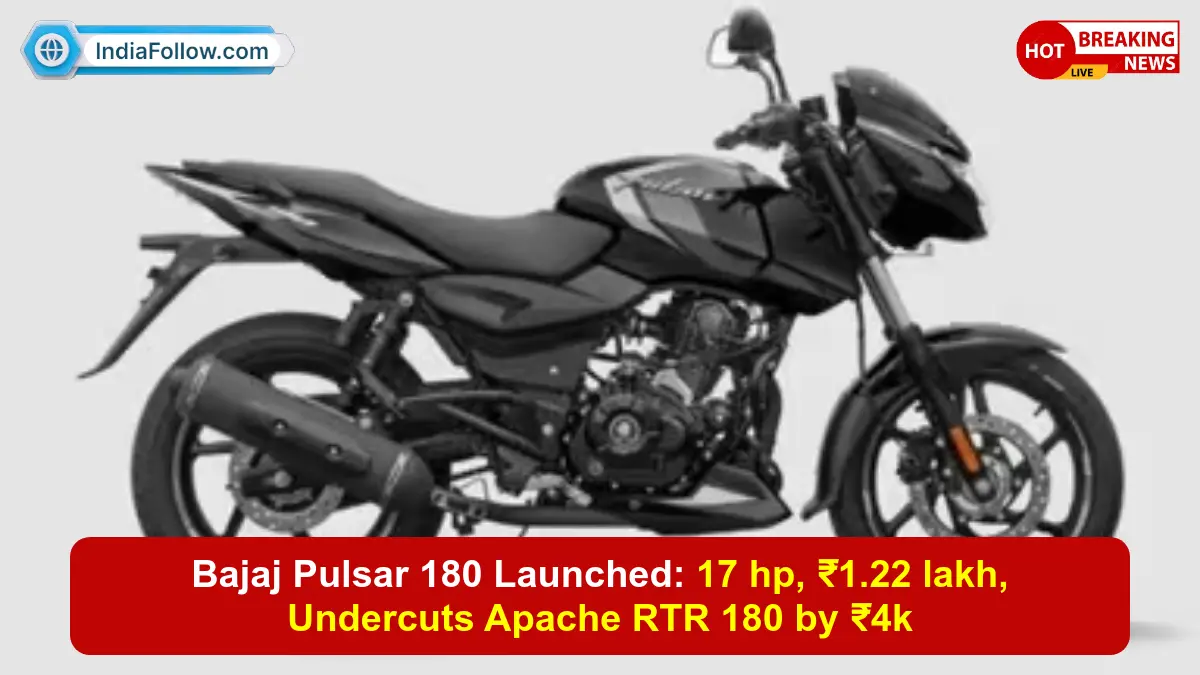
Bajaj Pulsar 180 is back on Indian roads, and the timing couldn’t be better. After a short break, Bajaj has slotted the refreshed 180 right between the Pulsar 150 and the 220F, keeping the classic street-naked vibe alive while throwing in a few modern touches.
At ₹1.22 lakh (ex-showroom Delhi) the bike is ₹4 000 lighter on the wallet than its closest rival, the TVS Apache RTR 180. Add five fresh paint schemes, LED lighting and a negative-LCD console, and you’ve got a package that feels both familiar and new.
Engine & Performance: 17 hp Air-Cooled Thumper
The heart remains a 178.6 cc single-cylinder, air-cooled mill, tuned for everyday pep and highway usability. It now belts out 17 hp at 8 500 rpm and 15 Nm at 6 500 rpm—a marginal 0.8 Nm bump over the earlier version. A smooth 5-speed gearbox sends power to the 17-inch rear wheel via an O-ring chain.
– 0-60 timing is expected in the high 5-second zone (Bajaj doesn’t quote official figures)
– Kerb weight of 156 kg keeps the power-to-weight ratio friendly for new riders
– 15-litre fuel tank gives 600 km+ range on relaxed throttle
– BS6-compliant but carburetted—no fuel-injection yet
If you rode the earlier 180, you’ll feel the extra torque while overtaking in city traffic; it pulls cleanly from 3 500 rpm without needing constant down-shifts.
Chassis, Ride & Handling: Old-School Geometry, New Tyres
Bajaj has stuck with the proven double-cradle frame, 1 320 mm wheelbase and 165 mm ground clearance. Suspension duties are handled by 37 mm telescopic forks up front and five-step preload-adjustable twin shocks at the rear. The setup is tuned on the softer side for Indian potholes, yet doesn’t wallow while flicking through traffic.
| Component | Specification |
|---|---|
| Front Brake | 280 mm disc, single-channel ABS |
| Rear Brake | 230 mm disc with ABS |
| Tyre Size (F/R) | 90/90-17 / 120/80-17, tubeless |
| Kerb Weight | 156 kg |
Tubeless rubber means fewer roadside headaches, and the combined braking system offers confident stops even when the road throws surprises.
Also Read: Google Veo 3.1 AI Video Generator Goes FREE: 10 Monthly Clips, New Soundtrack & Avatar Tools
Also Read: Kia, Mahindra & MG’s Upcoming Diesel SUVs: Launch Dates, Power & Features Revealed
Also Read: KTM 390 Duke Price Hiked by ₹40k: New Cost, RC 450 Global Launch & What It Means for India
Also Read: Maruti Suzuki Brezza, WagonR & Grand Vitara Facelifts Set to Launch Soon
Styling & Features: LED Headlamp Meets Negative-LCD Dash
Gone are the halogen days; the new 180 borrows the LED headlamp and twin-pilot lamps from the recent Pulsar 150 update. The negative-LCD console shows speed, rpm, fuel bar, two trip metres, clock and service-due reminder. Switch-gear quality feels positive, and the palm-friendly levers offer four-step reach adjust.
– Five colour options: Black-Gold, Black-Blue, Black-Grey, Black-Red, White
– Clip-on handlebars sit 20 mm lower for a sportier stance
– Pillion seat is longer and plusher, a boon for weekend rides
– Engine belly pan and tank extensions are colour-coded
The twin-barrel exhaust note still carries that trademark Pulsar burble—loud enough to announce arrival, quiet enough for late-night apartment runs.
Price & Variants: Single Trim, Multiple Colours
Bajaj is keeping things simple: one variant, five paint options. At ₹1.22 lakh it undercuts the TVS Apache RTR 180 by ₹4 000 and costs ₹12 000 more than the current Pulsar 150. That gap gives the 180 breathing space without stepping on the 220F’s toes.
| Model | Price (Ex-Showroom Delhi) |
|---|---|
| Bajaj Pulsar 180 | ₹1.22 lakh |
| TVS Apache RTR 180 | ₹1.26 lakh |
| Bajaj Pulsar 150 | ₹1.10 lakh |
Finance schemes start at ₹4 999 per month, and most dealerships already have the first batch of deliveries rolling out.
Competition Check: How It Stacks Against Apache RTR 180
On paper, both bikes trade blows in the 17-17.5 hp ball-park, but the character differs. The Apache revs higher and feels sharper around corners thanks to its double-barrel exhaust and stiff suspension. The Pulsar 180, on the other hand, offers a plusher ride, a slightly roomier seat and now, LED lighting that the TVS still misses.
– Apache gets a slipper clutch; Pulsar sticks to a conventional unit
– Both come with single-channel ABS, but Bajaj’s calibration feels softer at the lever
– TVS offers a fully-digital dash, while Bajaj mixes analogue tacho with LCD pod
– Service network and spares cost tilt in Bajaj’s favour in tier-2/3 towns
Choose the Apache if you crave track-day vibes; pick the Pulsar if commute comfort and after-sales reach matter more.
Quick Verdict
Bajaj hasn’t reinvented the wheel, but it didn’t need to. The Pulsar 180 gets enough modern touches—LED lights, negative-LCD console, fresh graphics—while retaining the torquey motor and comfy ride that made it a household name. At ₹1.22 lakh and ₹4 000 cheaper than the Apache RTR 180, it’s a value-packed re-entry that should keep both loyalists and new riders happy.
Bajaj Pulsar 180 : Important Questions
| Question | Answer |
|---|---|
| Is the new Pulsar 180 fuel-injected? | No, it continues with a BS6-compliant carburettor for cost control. |
| What is the real-world mileage? | Owners report 42-45 km/l in mixed riding; tank range is 600 km+. |
| Does it get dual-channel ABS? | Single-channel ABS is standard; rear wheel is un-sensed. |
| Will there be a faired version? | Bajaj hasn’t confirmed yet, but history suggests a 180F could arrive later. |
| How much is the booking amount? | Most dealers ask ₹2 000 refundable; deliveries are already underway. |