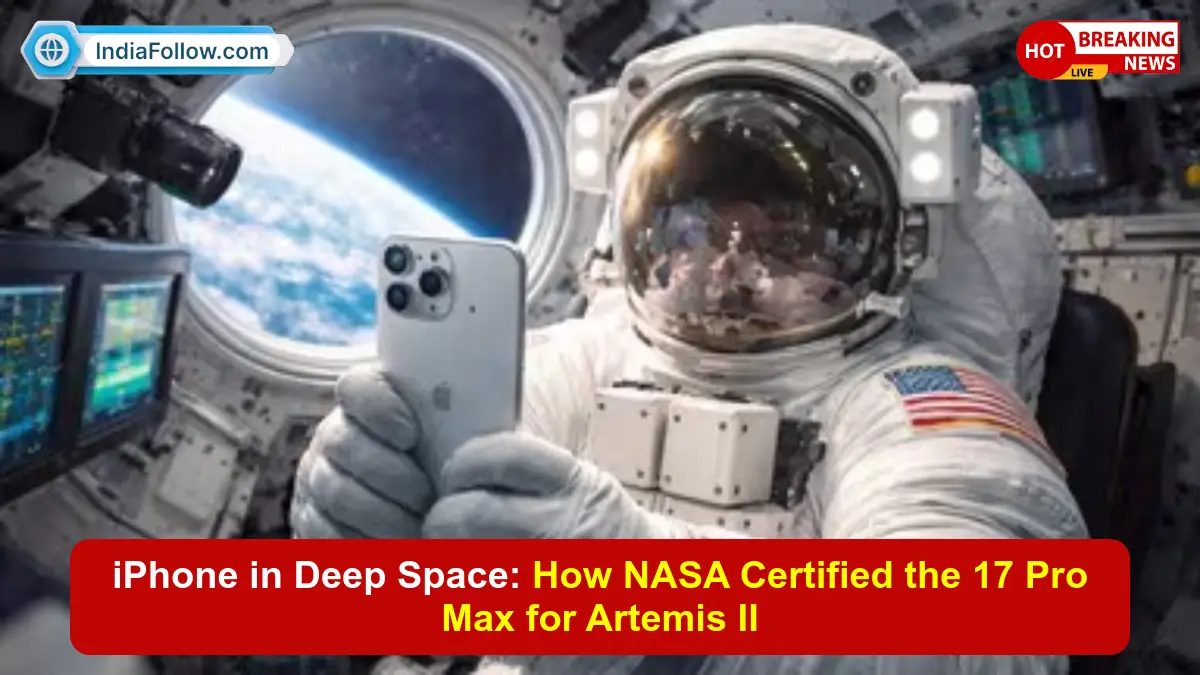
iPhone 17 Pro Max has left the planet—literally. NASA’s Artemis II crew is now using Apple’s flagship phone to film their historic trip around the Moon, turning a everyday gadget into a deep-space storyteller.
It’s the first time a consumer smartphone has been certified for a journey beyond low-Earth orbit. While professional cameras still handle the science work, the iPhone is adding a human touch to the cosmos.
Why NASA Picked the iPhone 17 Pro Max
The space agency wanted a lightweight, high-quality camera astronauts already knew how to use. After two years of radiation, thermal and impact tests, the iPhone 17 Pro Max came out clean.
- 48 MP quad-pixel sensor captures crisp 8 K video even in low lunar light.
- Titanium frame and Ceramic Shield survived shake-tests that mimic a rocket launch.
- ProRes recording lets crews store footage on device without network access.
- Special space-grade mounts keep the phone from floating in micro-gravity.
Only the camera, gyro and accelerometer are active; radios stay off for safety.
How Astronauts Shoot Videos in Zero-G
Floating inside Orion, the crew Velcro the iPhone to the craft’s window, hit record and carry on with their work. Because the phone is locked in place, there’s no risk of shattered glass drifting through the cabin.
- They shoot in 30 fps to match NASA’s archival standards.
- Footage is off-loaded to Orion’s main storage daily.
- Apple’s cinematic mode is disabled to save battery.
The result is smooth, selfie-style clips that bring viewers inside the capsule in real time.
Artemis II Camera Gear Comparison
| Device | Primary Use | Resolution | Space-Certified |
|---|---|---|---|
| iPhone 17 Pro Max | Personal videos | 8 K | Yes (Artemis II) |
| Nikon D5 | Science photos | 20.8 MP | Yes (since 2017) |
| GoPro Hero 11 | Launch/external views | 5.3 K | Yes |
The iPhone sits beside these pro bodies, not instead of them, giving the mission extra storytelling power at almost no added mass.
What Apple Had to Modify for Space
Everyday features can turn deadly in orbit. Loose glass, overheating batteries or rogue radio signals could spell trouble, so Apple and NASA stripped the phone down.
- Removed SIM tray to stop accidental ejection in micro-gravity.
- Sealed speaker and mic ports to keep dust out.
- Limited charging to 80 % to cut swelling risk.
Beyond these tweaks, the hardware is identical to the handset you can buy on Earth—proof of how rugged the flagship already is.
Quick Verdict
Artemis II proves a consumer phone can survive and film in deep space. If the iPhone 17 Pro Max comes back in one piece, expect future missions—and maybe even Mars crews—to pack their own pocket cameras.
iPhone 17 Pro Max in Space: Important Questions
| Question | Answer |
|---|---|
| Can the iPhone connect to the internet in space? | No. Wi-Fi and cellular radios are disabled; it works offline as a camera only. |
| How is the phone charged aboard Orion? | Through a NASA-certified USB-C cable linked to the spacecraft’s power bus. |
| Will the footage be live-streamed? | Not live. Videos are stored onboard and down-linked to Earth after the mission. |
| Could other phones be certified the same way? | Yes, but each model must pass NASA’s strict safety and radiation tests. |